SANZO JOURNAL · 装饰层的附着原理、烤花温度与色牢度、UV 与摩擦测试、保色年限
Fired-On vs. Spray-Coated Glass: The Real Story on Colorfastness
4 min read

A glass tumbler emerges from the kiln, its color vivid and saturated—like silk fresh off the dye bath. But the real test doesn't happen at the moment it leaves the lehr; it happens three years later, on cycle number two hundred in a commercial dishwasher. Colorfastness is the threshold every decorated glass product must cross to move from 'attractive' to 'enduring.'
Adhesion Mechanics: Mechanical Lock vs. Chemical Bond
Spray coating—including screen printing and post-PVD over-spray—relies fundamentally on mechanical adhesion. Ink or lacquer sits on the glass surface, held in place by microscopic surface roughness and resin tack. Fired-on decoration, by contrast, is a chemical bond: inorganic pigments soften at 520 °C–620 °C, penetrate the glass surface by roughly 10–30 microns, and upon cooling form covalent bonds with the silicate network. One is 'laid on top'; the other is 'fused in.' That single difference determines everything that follows.
Temperature, Testing, and Expected Lifespan
For every 20 °C increase in firing temperature, pigment fusion and penetration improve by approximately 15 %—yet exceeding 640 °C risks softening and distortion of the glass, so kiln zone control must hold within ±3 °C. Colorfastness validation typically rests on three tests: cross-hatch adhesion (ISO 2409), abrasion resistance (500 cycles each for dry and wet), and QUV accelerated weathering (313 nm UV, 200 continuous hours).
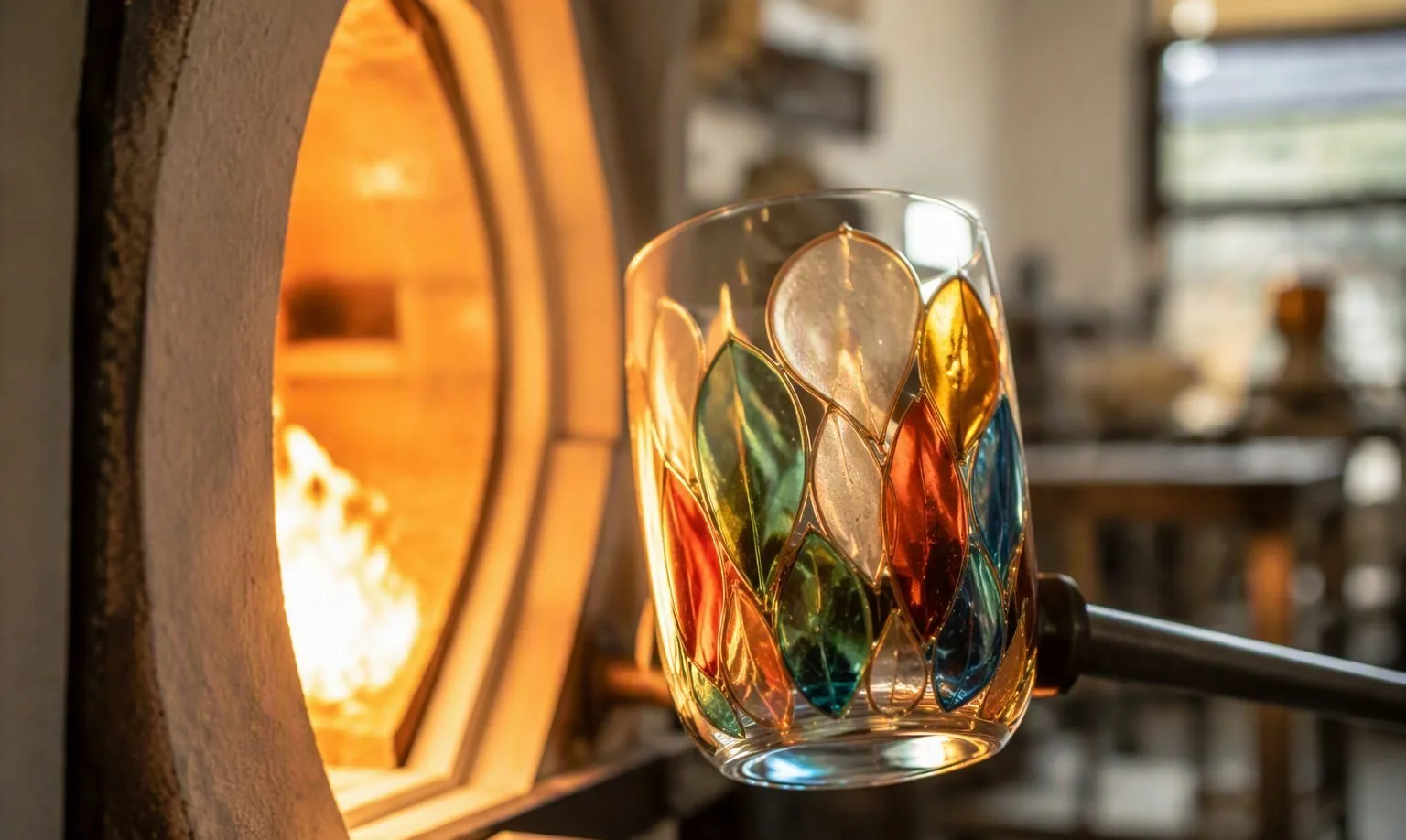
- Fired-on: cross-hatch rating 0 (no removal), ΔE < 1.5 after abrasion testing, ≥ 90 % color retention after 200 h QUV; expected service life 5–8 years under normal use.
- Spray-coated / screen-printed: cross-hatch rating 1–2; edge wear may appear after 200 abrasion cycles; some organic pigments begin to fade after 100 h QUV; expected service life 1–3 years.
- PVD (ion plating): sits between the two—high film hardness and excellent abrasion resistance, but poor resistance to strong alkalis; dishwasher environments require an additional pore-sealing step.
- Key variables: ink and pigment batch consistency, CTE match between coating and glass substrate, and kiln zone uniformity. Lose control of any one of these, and colorfastness data will swing dramatically.
The Sanzo Approach: Baking Colorfastness into Process Discipline
After fifteen years in Qixian—serving hotel and brand clients across more than 30 countries—the lesson we've internalized is this: colorfastness isn't inspected into a product; it's fired into it. Sanzo's 156 artisans and fully integrated post-processing line ensure that kiln-zone profiles, ink formulations, and pre-treatment cleanliness all fall under one unified process discipline. Every first-off piece from each kiln load undergoes cross-hatch and abrasion testing, with data archived for full traceability. We will never promise 'never fades'—that would be a lie that defies materials science—but we do promise this: within the agreed use case and service life, the color will hold up to both inspection and回访.
Bring Us Your Toughest Questions
Is your product a hospitality tumbler washed daily, or a low-use decorative object for the home? Is the target market the hard-water regions of North America or the soft-water environments of Europe? How large is the decorated area, and how many colors are involved? Every one of these variables shapes the right process choice and the realistic colorfastness expectation. Bring us your specific requirements—being a thoughtful supplier starts with answering the real questions.
fired-on glass decorationspray-coated glasswarecolorfastness testglass surface coating durabilityQUV accelerated weatheringcross-hatch adhesiondishwasher-safe glass printingglass decorating process
Reading this far means you choose suppliers carefully
Tell Xiaozhuo what you have in mind — a few sentences are enough; we handle the rest.
Start a smart inquiry