SANZO JOURNAL · 人工吹制玻璃器皿的验货把关全流程:外观/尺寸/应力/口部/稳定性,AQL 抽检逻辑
The Gauntlet of Light: Quality-Checking a Hand-Blown Wine Glass
4 min read
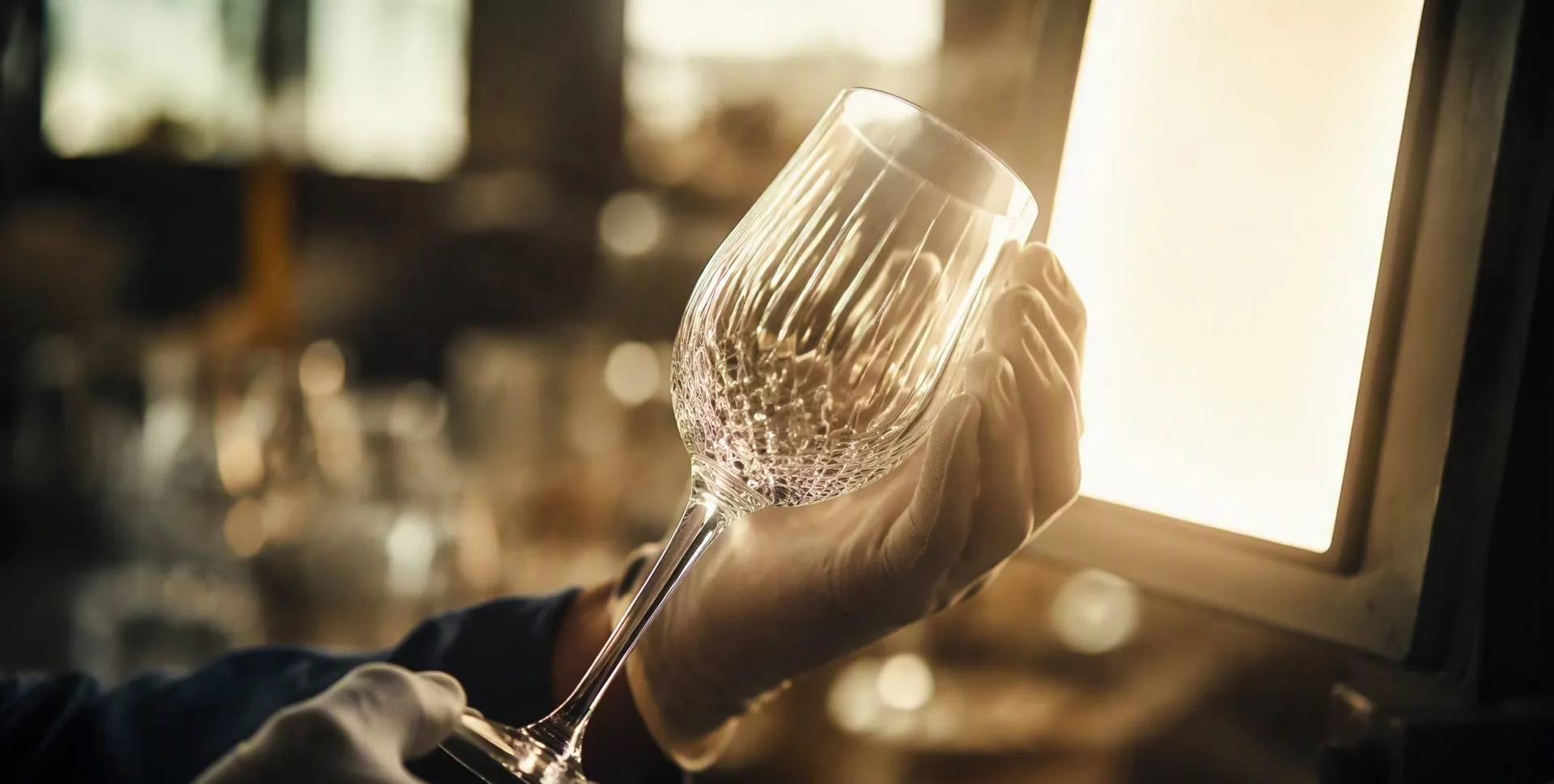
In the Qi County workshop, the inspection bay runs under a cool-white lamp around the clock. A craftsman carries a freshly annealed wine glass — still warm to the touch — into the light and rotates it slowly. The beam passes through the wall, magnifying any bubble, stone, cord, or rim irregularity into plain sight. Before a glass can truly leave the factory, it must first survive these beams.
Gate One: Visual & Rim — Where the Eye and the Lamp Collude
Visual inspection is the first hurdle and the one that rewards experience most. Under a 60 W cool-white lamp, the craftsman rotates the glass a full 360°, flagging bubbles, stones, scratches, mold seams, and cords. The rim is a separate hard spec: the glass is inverted on a calibrated surface plate and checked with a 0.05 mm feeler gauge. For hand-blown ware we are not chasing mechanical flatness — we are chasing a pour that does not drip and a rim that does not cut the lip.
Gate Two: Dimensions, Stability & Stress — Three Invisible Baselines
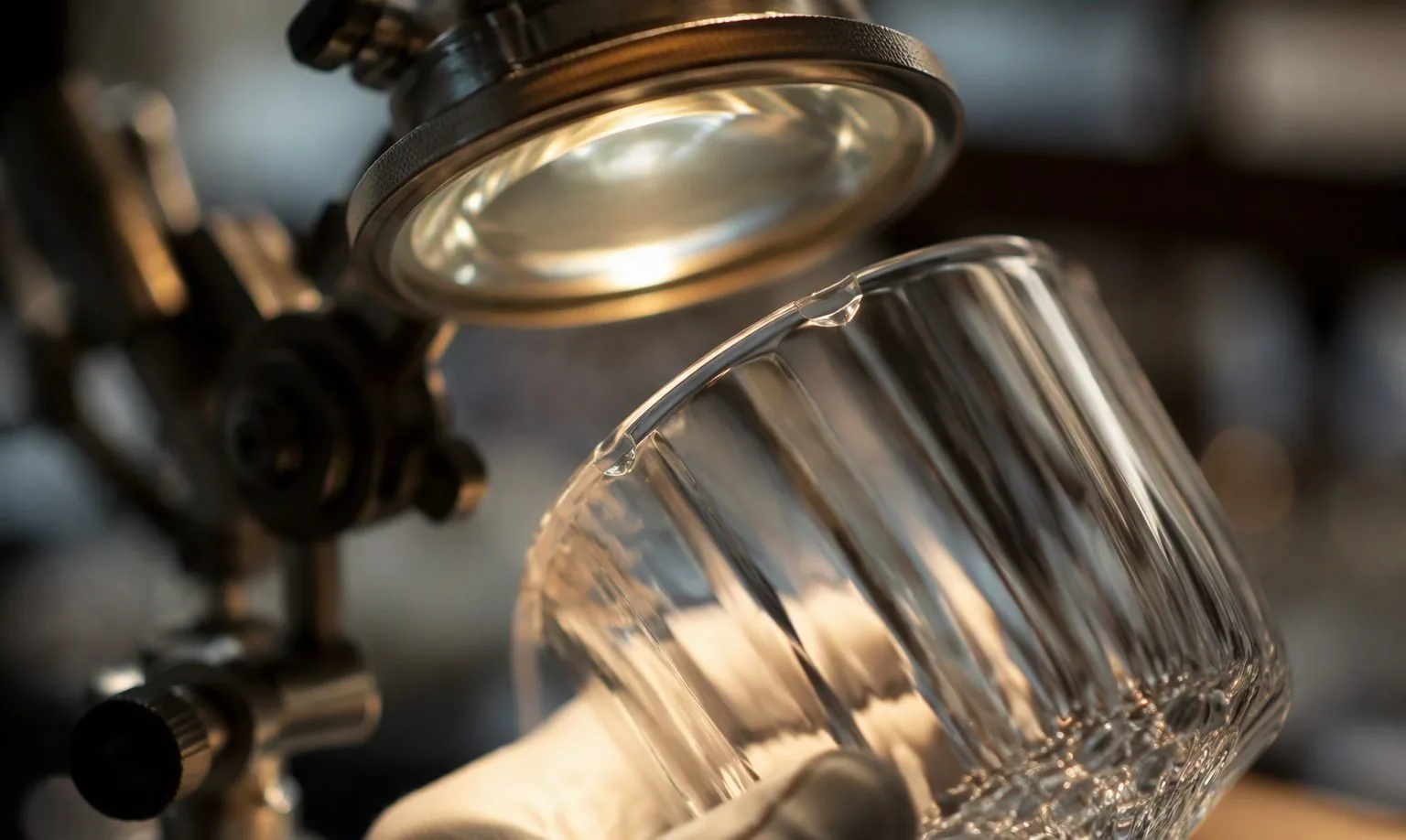
- Dimensional tolerance: height, top diameter, and base diameter held to ±1.0–1.5 mm per drawing, with a range of ≤1.0 mm within the same order — ensuring visual consistency when the set is displayed together.
- Base stability: the glass is placed on a 15° tilted glass plate; an empty glass must neither slide nor tip on its own, and a full 360° rotation reveals no rocking or wobble.
- Annealing stress: a random sample from each lehr load is examined in a polariscope. Interference fringes at the bowl-to-stem transition are kept within safe limits, preventing thermal-shock cracking down the line.
None of these three are judged by eye alone — they are verified with instruments and refined by feel. A glass's lifespan is often written in the last ten minutes of the annealing curve.
Gate Three: AQL Sampling — Let Probability Vouch for the Lot
Before bulk shipment we run AQL sampling per ISO 2859-1 (ANSI/ASQ Z1.4). General visual defects are held to AQL 2.5; functional defects — rim chips, excess stress, unstable base — to AQL 1.0; critical defects — cracks, breakage — to AQL 0. Inspection Level II is the norm, and the sample-size code is driven by lot size: for a 1,200-piece lot, 80 glasses are drawn, and the accept/reject numbers fall out cleanly. This system is not designed to second-guess the craftsman; it is designed so that every shipment bound for 30-plus countries is measured by the same reproducible ruler.
At Shangzhuo, the Light Is Added One Beam at a Time
Over fifteen years in Qi County — the heartland of hand-blown glass — Shangzhuo has welded together the hands of 156 craftspeople, a full secondary-process chain (kiln firing, cutting, frosting, ion plating, screen printing, laser etching), and an inspection standard that refuses to bend. We call ourselves a 'thinking supplier' — and that thinking lives not in slogans but in the angle of every glass turned under the lamp, in every interference fringe re-calibrated on the polariscope. Exporting to more than 30 countries is not a matter of luck; it is the certainty that comes from being checked, again and again, by the same light.
If you are working through inspection criteria, AQL levels, or secondary-process options for your next wine-glass order, bring your specs and your questions — the lamp is on, and the glasses are ready.
hand-blown wine glass inspectionglassware AQL samplingannealing stress testrim flatness toleranceglass QC supplierSanzoHomeQi County glassware
Reading this far means you choose suppliers carefully
Tell Xiaozhuo what you have in mind — a few sentences are enough; we handle the rest.
Start a smart inquiry